The 4-legged angular steel lattice tower is a freestanding, high-strength steel structure designed for critical infrastructure support. Characterized by its square-based four-legged frame and crisscross lattice connections, it serves as a reliable backbone for communication, power transmission, and other industrial applications worldwide . Unlike guyed towers that rely on external wires for stability, this self-supporting design stands independently, making it adaptable to diverse environments from urban areas to remote regions.
Adopts a square configuration with four vertical angle steel legs, connected by lattice trusses to distribute loads evenly and enhance stability .
Features a tapered structure—wider at the base and narrower at the top—to optimize structural integrity against wind, seismic activity, and ice loads .
Comes with integrated accessories such as equipment platforms, climbing ladders, cable trays, antenna brackets, and aviation light mounts for practical functionality .
Height ranges typically from 10m to 120m, with customization available to meet specific project requirements .
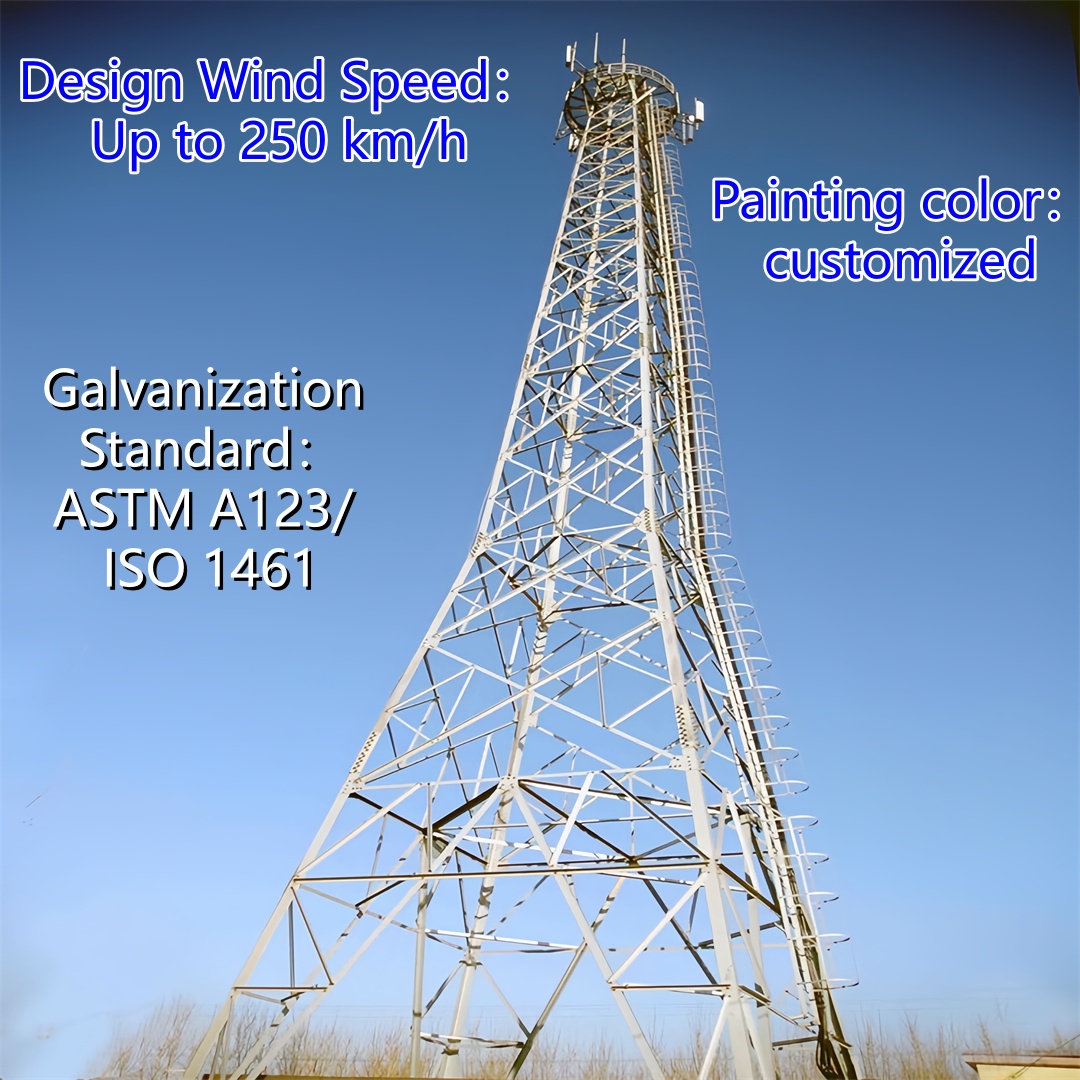
24 36 55 72m 4 Leg Steel Lattice Angular Mobile Telecom Tower
Primary materials include high-quality structural steels like Q235B, Q345B, and Q420, which align with international standards such as ASTM A36, S235JR, and ASTM A572 .
Fasteners (bolts and nuts) comply with ISO 898 grade 6.8 or 8.8 for reliable connections .
Surface treatment involves hot-dip galvanization per ASTM A123 standards, providing long-term corrosion resistance even in harsh outdoor conditions .
Welding processes follow AWS D1.1 specifications, ensuring strong and durable joint connections .
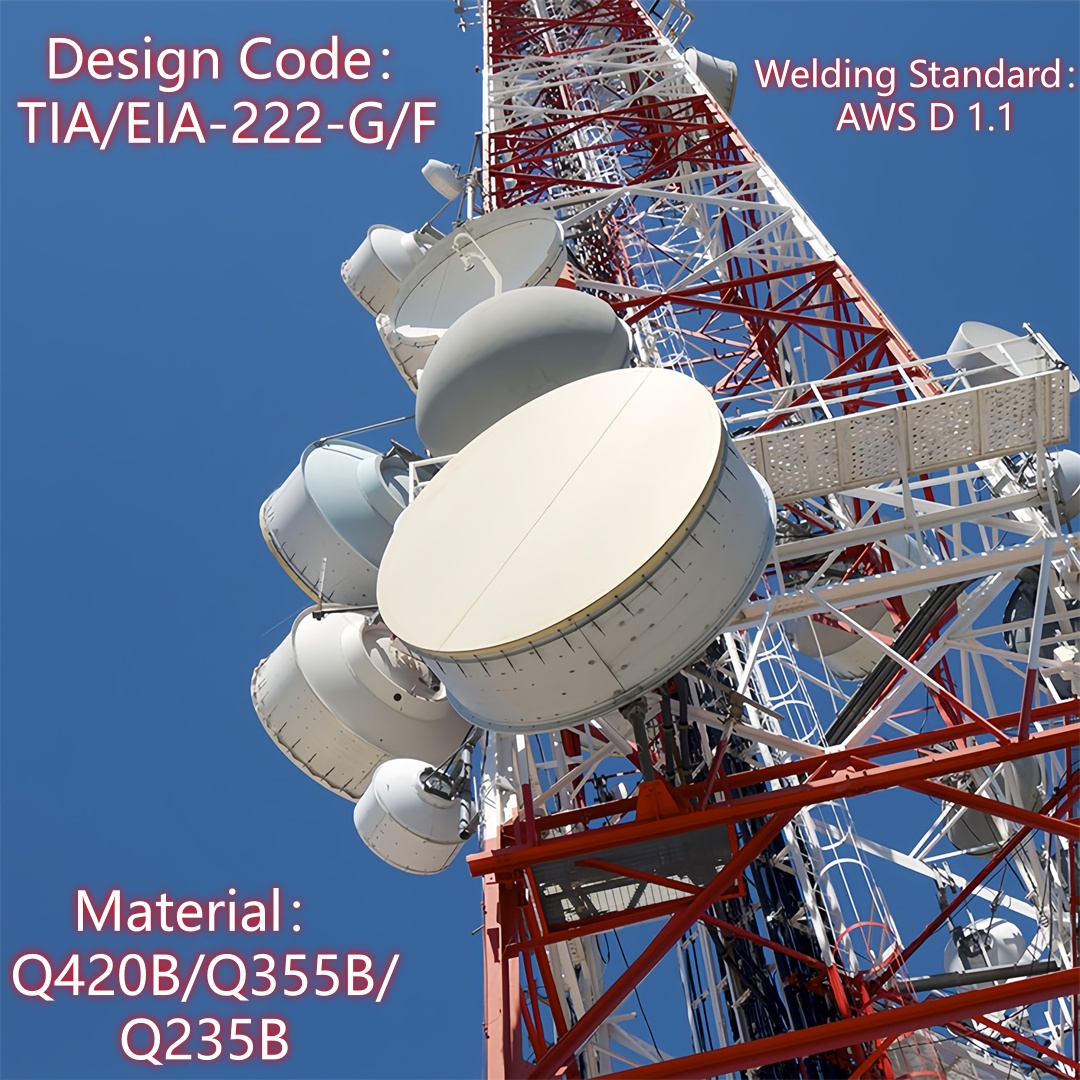
Wireless 5G Antenna Tower 4 Leg Angle Steel Iron Self-Supporting Telecom
Telecommunications: Supports 4G/5G antennas, WiFi equipment, microwave transmitters, and TV broadcasting devices to expand signal coverage .
Power Transmission: Carries high-voltage electrical lines (10kV to 500kV) for long-distance energy distribution .
Renewable Energy: Serves as a stable base for wind turbine generators, withstanding dynamic forces from rotor operation .
Observation & Surveillance: Provides elevated platforms for environmental monitoring, security surveillance, and weather tracking systems .
Emergency Response: Deployed for temporary communication networks during disaster relief due to easy assembly and disassembly .
Space-Efficient: Eliminates the need for guy wires, requiring minimal ground footprint (9-18㎡ typically) and making it ideal for urban or space-constrained areas .
Robust Load-Bearing Capacity: The lattice structure balances high strength with lightweight design, supporting heavy equipment while resisting extreme weather like strong winds (up to 330km/h) .
Cost-Effective: Prefabricated components simplify transportation and on-site installation, reducing labor costs and project timelines .
Long Service Life: With proper maintenance, the tower can operate reliably for over 20 years .
Modular Flexibility: Universal tower sections allow for easy expansion or reconfiguration to adapt to evolving equipment needs .
Conduct regular visual inspections to check for corrosion, deformation, loose bolts, or missing components .
Perform non-destructive testing (NDT) periodically to detect internal structural flaws that may not be visible .
Reapply protective coatings or replace corroded parts as needed to maintain corrosion resistance .
Verify bolt torque at major joints using calibrated tools to ensure structural integrity .
Comply with industry standards such as BS EN ISO 1461 for galvanized steel maintenance and local safety regulations .
As a cornerstone of modern infrastructure, the 4-legged angular steel lattice tower combines durability, versatility, and practicality to meet the growing demands of communication, energy, and surveillance sectors. Its mature design and reliable performance make it a preferred choice for projects worldwide.


Comments
Post a Comment